
By Bernie Schultz
Over the course of my career, Lake Wheeler has delivered some pretty heavy blows. At the same time, it’s provided some great finishes.
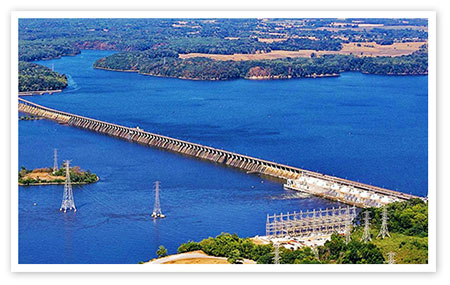
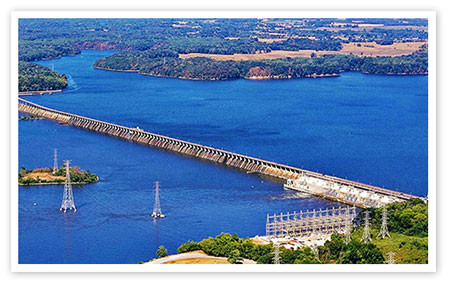
A view from below Wheeler Dam. Notice the bluff banks in the distance.
Part of the TVA chain of lakes, Wheeler boasts more than 68,000 surface acres and is home to a healthy population of largemouth, smallmouth and spotted bass. They’re usually easy to pattern, too.
I had high expectations.
Arriving at the home of Gene and Peggy Sue Barnette, our hosts for the week, I settled in with traveling companions Cliff and Kelley Prince. Cliff’s parents would catch up later in the week with his and Kelley’s two kids, Gracie and Syler.
It looked like a fun and exciting time ahead.
Getting Started
On day one of practice, Cliff and I drove to Mallard Creek to launch at mid lake. Our plan was to start shallow then work deeper as needed.
My first stop was to a protected pocket across the bay. Using a Hildebrandt SqueakEasy buzzbait and Terminator swim jig with white Swim Senko trailer, I combed shoreline grass and wood — hoping to find a shad spawn in progress.
The area looked perfect, but there was no evidence of shad or bass.
From there I motored to a ridge separating the bay from the main lake. Using a Rapala DT-Flat7, I cranked the entire length of the ridge … but to no avail. The only bite I got was from an oversized freshwater drum.
From there I moved back to the shallows, to a field of pads and waterlily. Those, too, looked good but no fish seemed to be using the area.
About that time, I received a call from Cliff. He said he, too, had tried shallow but that his only bites had come when he moved to the bluffs. Hearing that, I decided to head upriver to try the steeper channel swings — a trip that would take considerable time, yet one that might pay off.
Switching back and forth with the crankbait and a pitching jig, I probed several different bluff banks. There was no apparent current or any type of action. Growing tired of that, I began flipping large laydowns along flatter banks, but those, too, yielded nothing.
By day’s end I was tired and frustrated. Nothing was working and I needed a change of strategy.
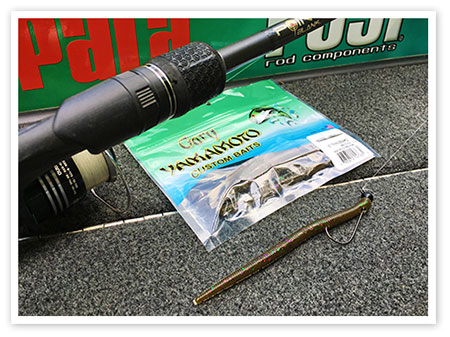
A shaky head Thin Senko and light line did the trick.
Over dinner, Cliff recommended I move to the bluffs down the lake. He reported plenty of bites and insisted the pattern was solid. I thanked him and said I would give it a try.
When morning came, my first stop was on a bluff wall outside of First Creek. In minutes, Cliff’s pattern proved itself. By noon, I had located several schools of largemouth and smallmouth. Hope had been fully restored.
On day-three of practice, I tried expanding the bluff pattern. As time passed, I noticed the fish weren’t quite as shallow as before. It seemed like they were pulling out some. I reported my findings to Cliff by phone, then headed to registration.
Game Time
The first morning of competition came quickly, but I was ready. When my number was called, I raced downriver toward the dam. When I arrived at my starting spot, I found it unoccupied.
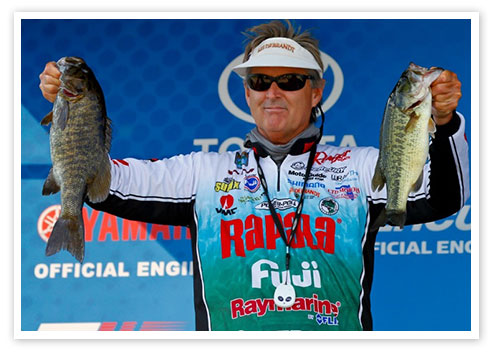
A mixed bag of smallmouth and largemouth kept me in the race.
In minutes I had my first keeper on a shaky-rig Thin Senko — a scrappy 2-pound largemouth. Minutes later, another keeper came aboard. I was sure the day would continue to be productive.
Moving farther down the bluff to a small rockslide, I finished my limit with a keeper smallie and two more largemouth. As the day progressed, I culled steadily using the shaky rig. Just before weigh-in, I boated my best fish — a 3¾ pound brown.
I was stoked. I thought my 13-pound limit would position me high in the standings. Soon, however, I learned otherwise: The entire field had caught good limits of fish and I was barely inside the cut. To insure a money finish, I knew I would have to do at least as good on day two.
When the next morning came, I returned to my best bluff bank. But after more than 30 minutes without a keeper bite, I knew something had changed. I moved to the rockslide where I had finished my limit the day prior, yet it produced only a single keeper.
At that point, I began rotating spots … hoping my timing might be right at some point, but I continued to struggle. With only an hour to go, I had three small keepers in the box. Finally, a skinny 15-inch smallmouth came aboard, and then it was time to head in.
Running toward check-in, I knew I would be short of the money. My thoughts at that point were more on the AOY standings: If I could somehow finish a limit, I could at least salvage some points.
Recalling a shallow brushpile near take-off, I decided to make a last second stop.
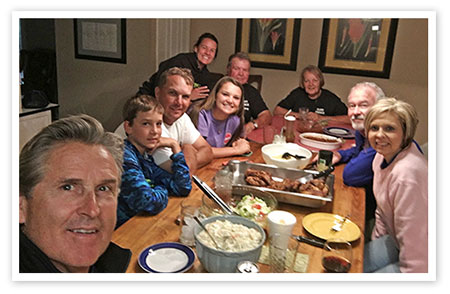
Staying with the Barnette and Prince families was a blast.
Bringing the boat off pad, I hopped to the bow, grabbed the shaky rig and fired a quick cast. Immediately, my line went tight and, after a short battle, I swung a 2-pounder into the boat.
As fast as I could, I boxed the fish, cranked the big Merc and raced to check-in … arriving with only forty seconds to spare.
At the scales, my modest limit dropped me from the top-50. But that last-minute largemouth had given me at least twenty additional AOY points. It had been a long, frustrating day, but I did all I could. The derby was over — for me at least — and it was time to put it on the trailer.
Back at the Barnette’s, we had a final dinner then said our farewells. Although the tournament didn’t go as hoped, I did enjoy the time spent with good friends. That always seems to take the sting out of a poor performance.
Yamamoto Products in this Article
Swim Senko
Thin Senko