
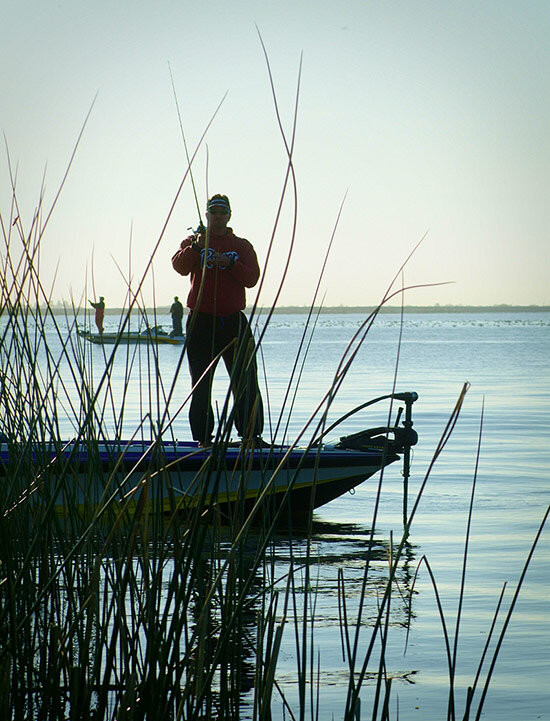
Everybody should fish the way they feel most comfortable, but there is a point I’d like to clarify. A lot of times, we hear anglers say they caught fish “flipping,” when in most cases, they actually were pitching. Flipping will always hold an important place in bass fishing history, but it has all but gone away in terms of a mainstream technique.
I do a ton of pitching because the advantages are just undeniable; starting with your distance from the target. Pitching lets you stay farther off the cover and the fish, so you’re not on top of them, spooking them with trolling motor noise or transducer noise. This is a really big deal in clear water, but day in and day out, keeping your distance is always beneficial.
The other thing is that you can be so accurate. With a little practice, you can put a bait in a coffee cup from quite a distance. In many cases, I’ll pitch 40-50 feet, rather than cast, because it’s such an easy movement and I know I can hit my target.
Also, pitching allows me a super quiet entry into the water. Your trajectory is really low and right before the bait hits the water, you thumb your reel to slow it down and it just slips into the water so quietly.
You know, flipping is a very accurate presentation too, but you’re limited on how far you can flip. I’d say that 95 percent of the time, I’m pitching; and the only times I really flip anymore is when up close enough to the target. For example, if I’m already into an area that I’m pitching and I see something that I overlooked going in, I’ll just flip to it because it’s close.
THE RIGHT RODS
I’m such a believer in pitching that I’ve built several rods specifically for this technique. Traditional flipping sticks are 7-6 to 8 feet, but a lot of times, you don’t need that big and heavy of a rod, if you have one with the same power in a 7-foot-3 length.
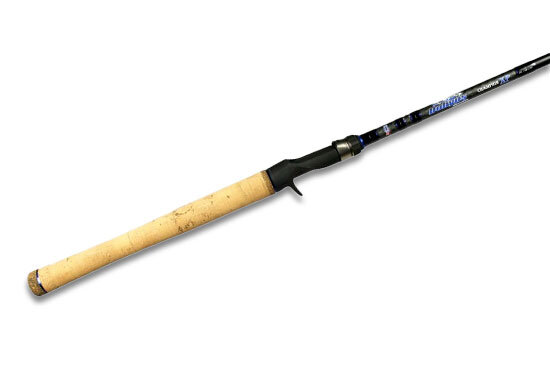
I’ve built a bunch of these 7-3 pitching rods and I make them lighter and easier to handle. These rods have soft tips for accuracy and you can hold them all day with minimal fatigue. Also, these rods can pull double duty for frogging — it’s like having a light baitcaster in your hand, but it still has flipping power.
My personal favorite is a Champion 736 Pitching Stick and I have three different line choices, based on where I’m fishing. In vegetation, I’ll use straight 50-pound braid. Occasionally, I might use 65, but if the cover is that thick, it’s usually more of a punching scenario.
In really clear water, I’ll often use 20- to 25-pound fluorocarbon. The middle ground is when I use braid for my main line, but I feel a fluorocarbon leader will help me get a few more bites.
In this scenario, it’s important to point out that I use actual leader material, not just fluorocarbon line, because it’s a little more durable. Also, I’ll use a 4-foot leader because it’s long enough to prevent the knot from going through the guide — that’s something that will decrease your accuracy.
BAIT SELECTION
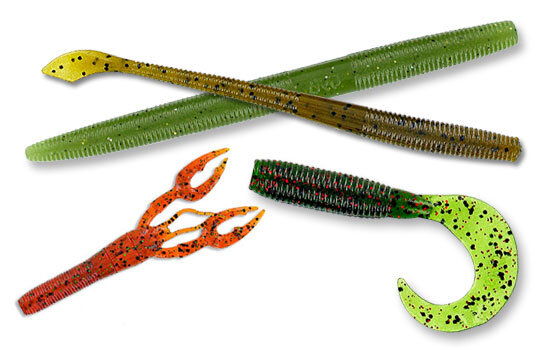
Yamamoto makes a lot of great baits for pitching, but I’ll tell you, one of my all-time favorites is a 6-inch Senko. I’ll pitch this bait unweighted into pockets with reeds or other light vegetation; and if I feel like the bait needs a little help getting through the cover, I’ll add a bullet weight.
As a side note, I don’t think enough people realize that the Senko makes such a great option for punching. Because of its straight profile, there’s nothing to drag on the vegetation; it follows that punch bait right into wherever you throw it.
This also means you can punch a Senko with less weight than a bulkier bait. For example, I’ve fished with a friend who was having trouble getting his bait through the mat with a 2-ounce weight, but I was getting my Senko through with a 1-ouncer.
I’ll also pitch a jig and even though I like the Yamamoto Twin Tail Grub, I’ll pitch with a single tail grub; especially, if I’m fishing a lot of cover. My other jig trailer is a 3.5-inch Baby Craw and if I’m pitching a traditional Texas rig, I’ll usually go with a Yamamoto Kut Tail worm. For all of these baits, I keep my colors simple; I honestly think it’s almost 100 recent reaction strike.
MY PRESENTATION
The pitching technique works for a wide variety of scenarios, but my favorite targets are holes in vegetation. I’m not punching, I’m looking for places I can send my bait without a lot of resistance and anytime you find a hole in grass, pads, etc., there’s usually a fish in the area. I’m also pitching on the outside edges, but even here, I’m always looking for some type of hole to pitch my bait into.
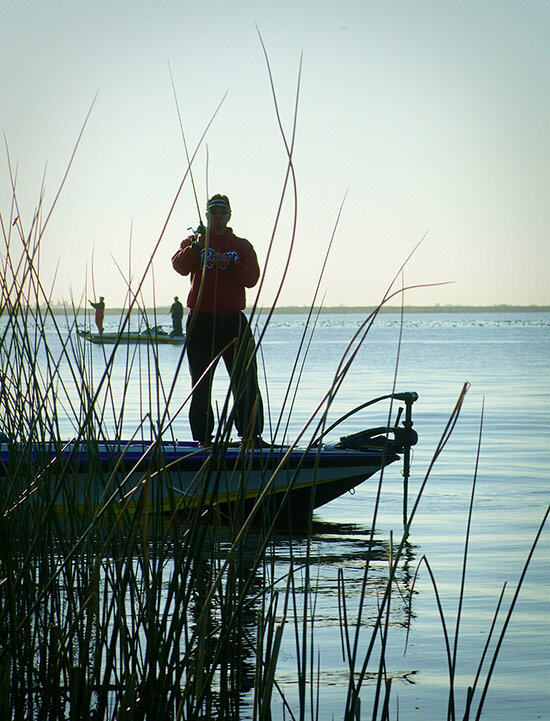
I also like to use the pitching technique for vertical cover. Depending on where you’re fishing, that could be tules, reeds, cattails or other tall, thin vegetation.
As far as pitching styles, there are two basic techniques. One involves lightly palming the bait to load the rod tip, dropping the bait and using your rod motion to propel it forward. This is what I do when I need to be as accurate as possible so I can put the bait into a small hole. This technique also allows me more distance, so I’ll use it when I’m trying to hit targets at a longer distance.
The other method involves hangin the bait a few feet off the rod tip, swinging back to build momentum and then swinging forward for the pitch. Because I never touch the bait, I can be more efficient when precise placement is less critical.
Now, the only drawback to pitching is that you’re often fishing in places where fish can become entangled in the cover. If this happens, and keeping steady pressure on the fish doesn’t force him out, I’ll go right into the cover to get him.
This is not my preference, of course, because you end up blowing out your spot that way. But that’s just part of the game; and if you don’t get wrapped up now and then, you’re not fishing in the right spots.