
By Jonathan LePera
Anglers have always struggled with deep-water bass relating to weed edges feeding on forage. If they were munching on crawfish, a bulky jig and soft-plastic trailer would work perfectly. Fishing a mid- to deep range crankbait makes sense, until it gets gummed up with weeds. Do that a few times and your patience is sure to wear thin, not to mention just how inefficient it will make your efforts to cover water.
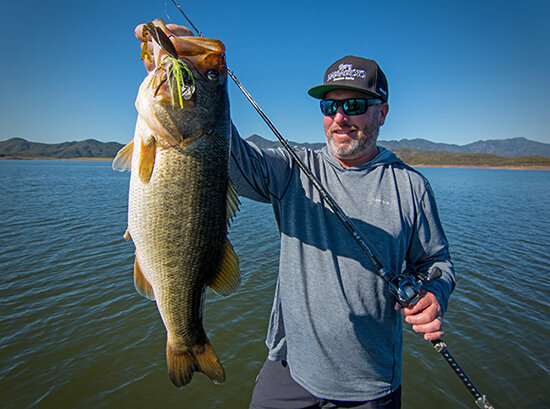
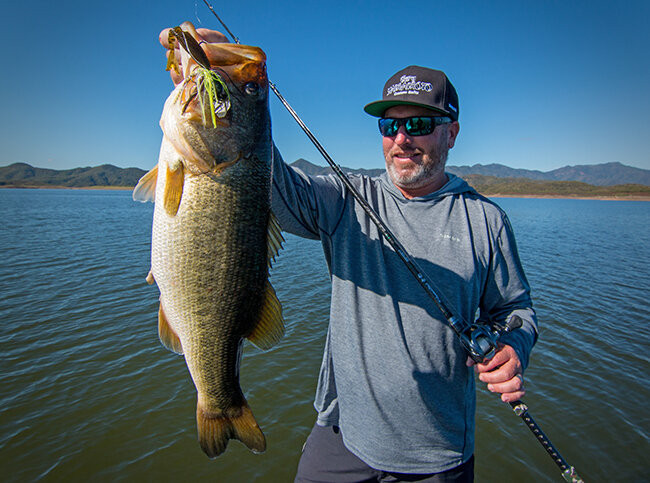
Major League Fishing angler, Brett Hite, redefined the power fishing game through his dominance with the Z-Man/Evergreen Jackhammer. “The Evergreen Jackhammer is a tournament proven winner. It’s not just me promoting it, it’s guys not even sponsored by Evergreen or Z-Man,” he said.
Posting consecutive wins on the BASS and FLW circuits in 2014 while fishing a bladed jig, Hite unleashed a fury upon the fishing world that had everyone jacked up. Retailers are still re-ordering as soon as the inventory arrives—they move out the door that fast.
Though Hite cut his teeth early in his career fishing deep water with finely tuned electronics, his intense knowledge and application of the Z-Man Evergreen Jackhammer in key situation has elevated his game. While the 3/8- and 1/2-ounce sizes still hold their place in shallow water when fished above vegetation or when keeping the bait closer to the surface, Hite realized heavier models could make the bait increasingly versatile.
Never before could a power-fishing bait reach 15-feet or deeper that fished well around vegetation. Lipless and conventional crankbaits often proved inefficient with so many casts lost to fouled hooks. Even a slow rolled spinnerbait suffered from weeds and sludge fouling the swivel thereby preventing the blade from spinning freely.
Hite realized that a heavier bait tracked straight at deeper depths and with a hard rip, he could clear the bait of any vegetation. He’d tried letting the 1/2-ounce model sink to the bottom in 15-feet of water; naturally it wanted to rise towards the surface early into the retrieve. He knew that heavier 3/4 and 1 ¼-ounce versions were essential.
On Northern bodies of water, like Cayuga Lake in Syracuse, New York, he’s found largemouth relating to deeper outside grass lines in 8- to 12- feet of water. Paralleling those weed lines with a 3/4-ounce bladed jig proves most effective for him. Areas with rock mixed into them are a bonus, but a grass line with key points is sufficient. He also likes the 3/4-ounce model fishing reservoir lakes when bass are 8-feet and deeper in the water column.
The heavier 1 ¼-ounce excels when targeting water 15-feet and deeper. He’ll make super long casts across a big flat with sparse weeds to whip nearby smallmouth into a frenzy. When targeting largemouth, the heavier bait let’s them show their preference. When bass need a more active approach, Hite will “yo-yo” the bait up off the bottom lifting the rod tip just enough to feel the jig vibrate before letting it fall back down. Most often, he’ll start off testing the mood of the fish by slowly pulling the rod to the side to crawl it along the bottom using a “sweep and reel” cadence facilitating maximum bottom contact while keeping him in the perfect position to sweep set on the bite.
Once he feels a “thump” or his blade stalls out, Hite reels the slack until the rod loads before driving the hook home, his drag always locked, ensuring a solid hookset. “An overhead hookset is a recipe for disaster. The blade will knock their mouth open every time,” Hite said. The key is to always “reel-set” and allow the rod to load before setting the hook.
The slower 6:3:1 gear ratio in the Daiwa Tatula Elite casting reel, spooled with 20-pound Sunline FC Sniper paired with the a 7’3’’ Evergreen Heavy Action Bass Rod has plenty of backbone and allows the Jackhammer to produce a hard-rocking side-to-side cadence. The blank through handle design allows for Hite to always feel his jig pulsating — and when it stalls, indicating a bite. “No one makes a heavy action glass rod like this. Most glass rods, they’re like a small crankbait rod, and don’t have the power that this one has with the parabolic action,” Hite said. The slower parabolic action carefully tires the fish by absorbing its energy thus reducing its ability to throw the jig.
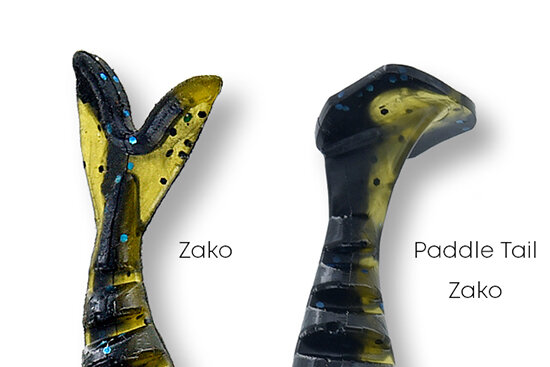
Equally important was designing the perfect trailer to compliment the action of the vibrating jig; maximum vibration and a consistent realistic action were key. Hite also didn’t want to have to fuss with the bait by trimming it down to aerodynamically fit the jig properly. Instead, he’ll fish the Zako out of the package, thread it onto the bait keeper and fire off the next cast. The center line on the top of the bait allows for perfect rigging and a bladed jig that runs true with every cast. With the appearance of a bigger baitfish and a protruding belly, it’s poured with salt-free plastic, the same used with Yamamoto’s saltwater baits. “Less salt stiffens the plastic slightly which produces the action I’m after for this setup,” Hite said.
The thinner swimbait tail of the original Yamamoto Zako shows up better in cleaner water and during the colder months of the year. Bass are looking for a more subtle action to suit their subdued metabolism. Once the water warms up or when bass are deeper and there is less light penetration, the added vibration of the boot tail design featured on the Yamamoto Paddle Tail Zako helps bass find the bait and triggers them to strike.
“Fish will change the preference of the trailer day-to-day and sometimes throughout the day. Let the bass tell you what they want,” Hite said. During the retrieve, he’ll always retrieve the bait steadily matching the speed of his reel to avoid overworking the bait.
When emulating bluegill, Hite’s favorite darker skirt colors are Green Pumpkin, B Hite Delight and Bruised Green Pumpkin. He’ll always match the color of his trailer to the skirt of his jig which is why Hite specifically had the color patterns for the Zako trailers created to match most skirts offered for his Z-Man/Evergreen Jackhammer. He will dip the tail of his trailers in chartreuse to make his offering even more realistic or if he feels they need a target to hit in colored water. For clear water conditions or when they are feeding on bait, Clearwater shad and Green shad are good choices. In darker water, brighter colors like Fire Craw or Chartreuse/White show out.
Yes, you should also have a swim jig rigged up as well. In heavily pressured waters where bass are seeing a bunch of bladed jigs come through their area, or under glass conditions with high skies and no wind, the subtle profile of a swim jig can clean-up.

*Editor - check out this great footage of Brett fishing the heavier chatterbait on Wired2Fish’s latest youtube video: