
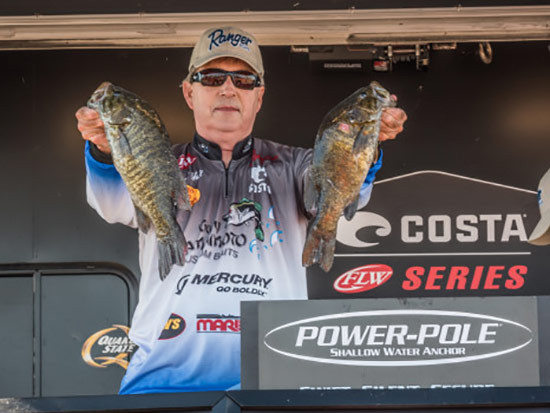
Boasting more than 45,000 surface acres and 640 miles of shoreline, Lake Eufaula is big … and it’s full of bass. Although several species swim there, it’s the reservoir’s abundance of big largemouth that decide tournament outcomes.
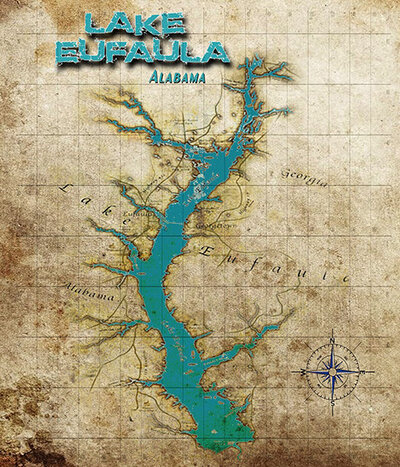
Spanning more than 70 miles north to south, Lake Eufaula helps form the border between Alabama and Georgia.
To find them in June normally requires hours of scanning with your electronics — combing the reservoir’s countless ledges and flats for anything that might hold schools of fish. This year, however, things were different. The moon triggered a mayfly hatch, along with a major bream and bluegill spawn. Those combined with unusually high water created a very strong shoreline bite — something that eluded many of the competitors.
Thirty days prior to the event, I spent two days scanning several areas of the lake with my Garmin electronics. In two major creeks, I found numerous brushpiles holding a few fish. My hope then was that they would improve over time.
Getting Started
On the first morning of official practice, I decided to visit some key places that had produced in the past — areas close to our take-off location at Cowickee Creek, on the northern end of the lake.
My first stop was to a main-river shoreline covered in water willow and lotus pads. There, I rotated several lures — including a full-size Terminator Popping Frog, 3/8-ounce Terminator swim jig with Yamamoto Zako trailer, and a 1/2-ounce Hildebrandt SqueakEasy buzzbait. The bites came quick, but none were of the size required to do well in the competition, so I moved farther upriver to try some other areas.
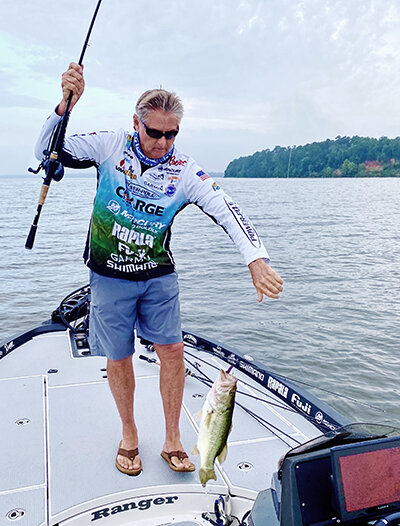
Offshore ledges were key places for many of the competitors, myself included.
In one spot, I found a group of fish holding in an isolated field of pads. In another, I found them by punching a Yamamoto Fat Baby Craw through a thick mat of floating vegetation. The fish felt heavy in both locations, so I marked them with my GPS and moved on.
Running farther to the south, I spent the remainder of the day scanning deep-water ledges along the main river channel, but to no avail.
On day 2 of practice, I started on the bank and then resumed the search offshore.
Eventually, I found some brushpiles placed along a deep ledge that appeared to be holding fish. I made a few casts and caught a couple of 14-inch keepers, but nothing more. From there I drove to the bottom end of the lake to revisit some of the brushpiles I found before cutoff. To my surprise, they were holding numbers of fish. My confidence was building.
On day 3, I spent most of my time scanning for brush — hoping to expand the pattern. My target areas included docks and ledges, and by day’s end I had marked numerous key spots. One in particular was a main-lake drop on the inside bend of the river channel. When I first idled over it, my electronics lit up like a Christmas tree. In just a few quick casts, I shook off what felt to be several heavy fish.
Stoked, I knew this would be my starting spot.
Tournament Time
When the official text from B.A.S.S. came, I learned I was boat number 60. My heart sank. I wondered if I would even get to start on the deep-water drop I had found the day prior. With so many ace structure fishermen in the field, it was certain several had found the same spot. It was too obvious.
Eventually my number was called and I raced south below the bridges, hoping to find an opening. As I drew closer to the coordinates, I noticed only one other boat. It was Alabama pro, Steve Kennedy, and he was fishing to the south of where I wanted to be.
I couldn’t believe it! How could he and the others have missed those schools of bass?
After dropping the trolling motor, I began scanning with the Panoptix and, to my dismay, the ledge appeared to be void of fish. Where did they all go?
Knowing what was there the day before; I felt I had to try it anyway.
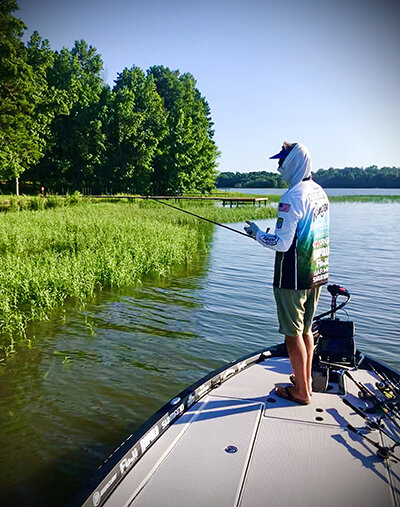
Shoreline grassbeds like this produced some good catches, using a variety of lures and techniques.
A half hour later, I hooked up with a couple of back-to-back two pounders. In another 30 minutes, two more. By 7:30 am, I had a limit weighing approximately 12 pounds. Although that weight was disappointing, it settled me and I began to build from there.
Around 10:30 am, I pulled the trolling motor and moved to the brushpiles I had found before cutoff. In the first pile, I caught a 4-pounder using a 10” Yamamoto Kut Tail Worm rigged to a VMC Swingin’ Rugby Jig. In the next pile, I landed a 3-pounder. Then things went dry. So I moved to the bank and spent the next few hours fishing around some bream beds.
After no luck there, I returned to the deep-water starting spot where, with less than an hour to fish, I boated two more close to three pounds. Then it was time to head in.
Back at the scales, I registered a weight just shy of 16 pounds. Although it felt good at the time, I soon learned that I was well behind the pack. It’s also when I learned that the shallow bank bite was on.
I had work to do!
Competition —Day Two
That night I contemplated my options and decided to start once more on the deep-water ledge, then try the bank and some brushpiles. The next morning, however — after just a few nonproductive casts — I was through fishing deep.
On the first stretch of bank I moved to, I got two quick bites with a swim jig. One was a 3-pounder, the other pulled off. Thirty minutes later, I scored a 5-pounder. Just when I thought things were looking up, the action died. It took two more hours to finish my limit, and those bites were small.
From there, I went to my brushpiles and made a couple of small culls.
With time running out, I decided it was time to make a move. I pulled the trolling motor and ran 20 miles north to my floating mat upriver — the place where I shook off a couple of good fish on the first day of practice.
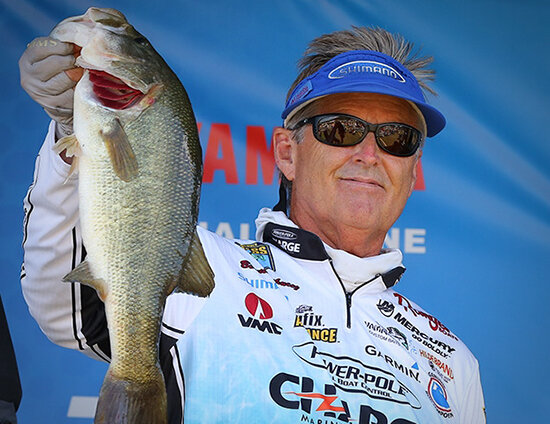
I caught my biggest bass by swimming a jig in shallow grass. One more like this one and ... who knows?
Rounding the final bend in the river, I found another competitor easing off the spot. As he pulled away, I considered my options: Fish the mat behind him, or run to another area. I opted to stay.
The mat extended far from shore, so my hope was that he had hit only the deep edge. My bites came well inside. With that in mind, I plowed directly into the interior to reach an old seam closer to the shoreline.
Soon after making my first pitches, I got a bite. Unfortunately, the fish dropped the bait. After a few subsequent flips and no takers, I abandoned that and raced to a field of lotus pads near check-in.
With the clock ticking, I boated two quick fish — one of which was a 3-pounder on the Kut Tail Worm. That helped, but would it be enough?
Back at the scales, it was apparent the catch was off. Having a total two-day weight of more than 30 pounds, I knew I was close to making the cut. But as each of the remaining anglers crossed the stage, my chances waned.
When it was all said and done, I missed by a pound.
Looking back, I don’t really have any regrets. I fished cleanly and to the best of my ability. I made the best decisions I could given the cards I was dealt. Had I gotten just one more key bite, things would have turned out a lot better. But they didn’t, and now it’s on to the next one.
The tour is headed north to New York for three back-to-back events. My time is coming!