
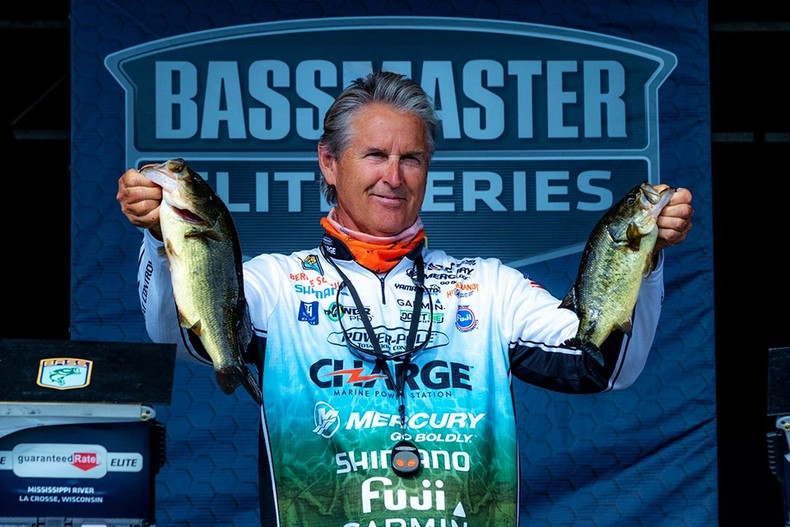
The Upper Mississippi is nothing like its “Big Muddy” version in the south. Its northern waters are generally clear and lush with vegetation. Among its manmade features are wing dams, spoil islands and riprap seawalls.
Both smallmouth and largemouth bass inhabit the river, and they are usually receptive to a wide range of lures — including hollow-body frogs, topwaters, bladed jigs, swim jigs, spinnerbaits, crankbaits and all kinds of soft-plastics.
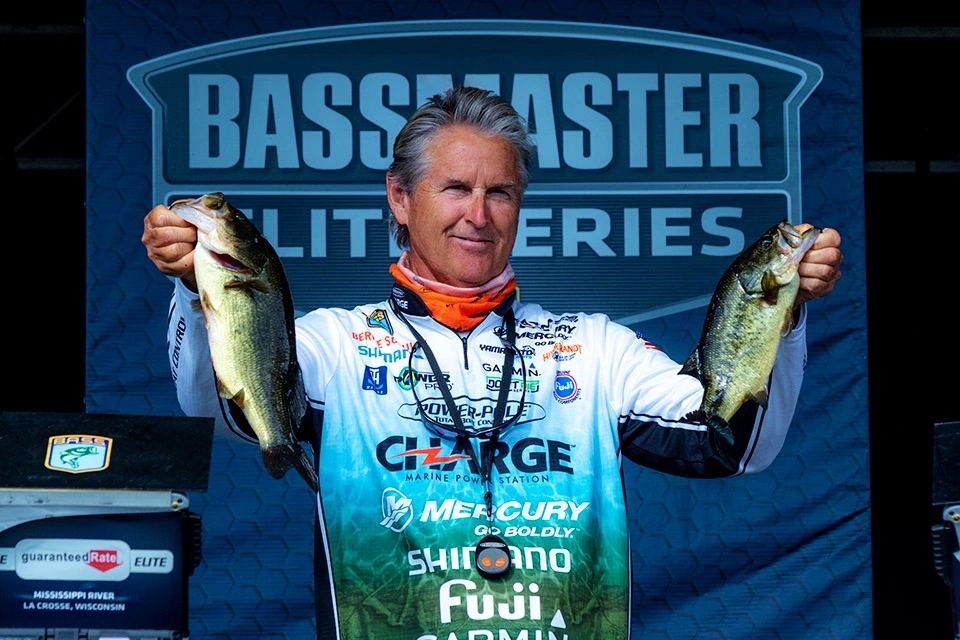
Our tournament waters included Pools 7, 8 and 9, with the City of La Crosse, Wisconsin serving as the official take-off site in Pool 8.
Having competed on this section of the river numerous times before, my focus was on Pools 7 and 8. To me, they offer the best range of habitat and are the quickest to access. It’s just a matter of finding the better quality fish.
Practice Begins
On day 1, I launched at a small ramp on the west side of the take-off pool. From there I motored directly across the river and began my search.
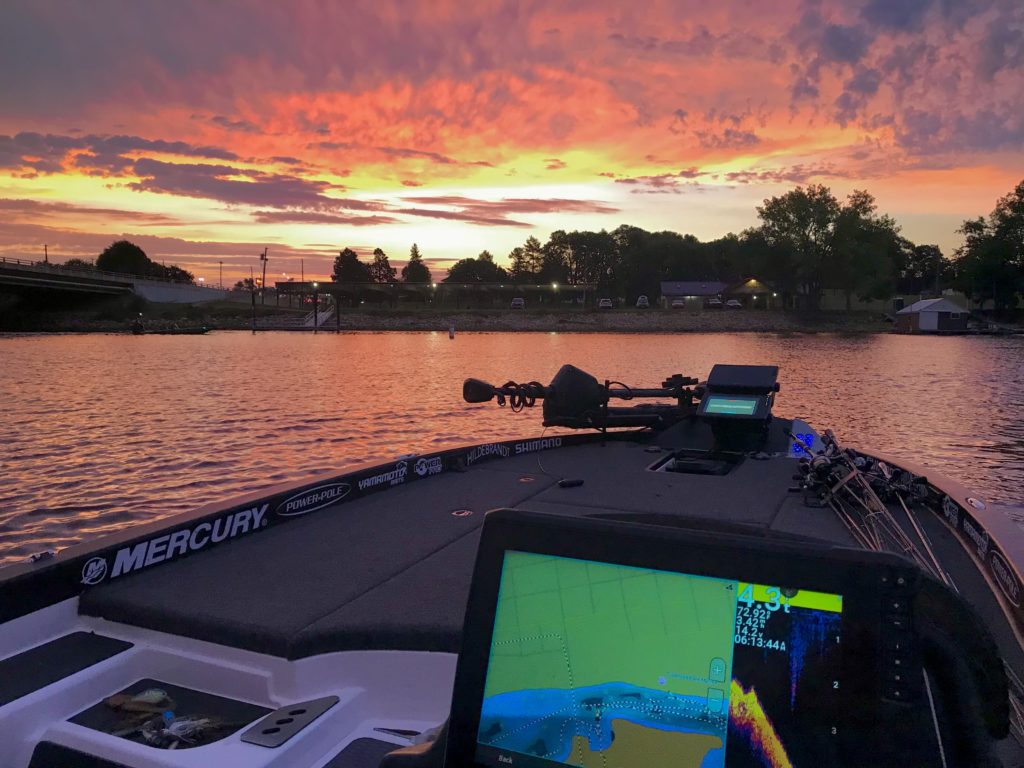
Among the places I tested first were shallow wing dams and island points. I also targeted laydowns, snags and the edges of reeds and submerged grass — all in close proximity to each other.
In no time, I was connecting with quality bass — both largemouth and smallmouth.
It was easy … almost too easy. The fish responded to a variety of lures and techniques, and they were aggressive. But other than being shallow, there was no clear pattern.
From there, I ventured downstream to a series of manmade spoil islands. Alternating with a 1-ounce jig tipped with a Yamamoto Fat Baby Craw and a 3/4-ounce Texas-rig Fat Baby Craw, I punched the edges of reeds lining the shoreline. And within minutes, I was shaking off what felt like heavy largemouth.
I spent the remainder of the day trying to expand the pattern, but only that initial area seemed to hold the right size and number of fish.
On day 2, I drove to Pool 7 and launched at Lake Onalaska.
Located just above the weir dam that separates the two pools, the lake is covered in topped-out grass. Yet, as pretty as it looked, I never got a single bite.
From there, I moved to the river channel to try several wing dams.
On my first stop, I caught numerous smallmouth. But most were short of the 14-inch requirement. Nearby was a secondary channel, which led to a small flat with reed edges like those that I found in Pool 8. And I was quickly rewarded with several decent bites.
Continuing along the edge, the flat narrowed to an intersection of three small tributaries — one of which had a field of lotus pads covered in duckweed.
In just a few casts with a frog, I got three bites. Filing that into my memory, I immediately left, hoping to find other areas like it. Unfortunately, I never did. By late afternoon, a line of violent thunderstorms moved into the area, dumping inches of rain. And though I didn’t know it at the time, that downpour would play a huge factor in the outcome.
On the final day of practice, I returned to the small ramp in Pool 8, hoping to expand on what I found earlier.
Once in the water, I could see it was much lower than before. Apparently, the Corp of Engineers had dropped the level to compensate for the heavy rainfall, and that was a major concern. The flipping fish I located on day 1 were in less than two feet of water. Thinking that bite would likely suffer, I decided to check the flats near Stoddard Landing — a large area defined by meandering secondary channels flanked by fields of grass and a massive riprap retaining wall.
The area is so large and looks so attractive, it took hours to sort through just a small percentage of it. And that search proved futile. By day’s end, I was more confused than when I first arrived in La Crosse.
Competition Time
Drawing out in the third flight, I exited take-off and raced to the flipping fish down lake … hoping there was enough water to keep them there.
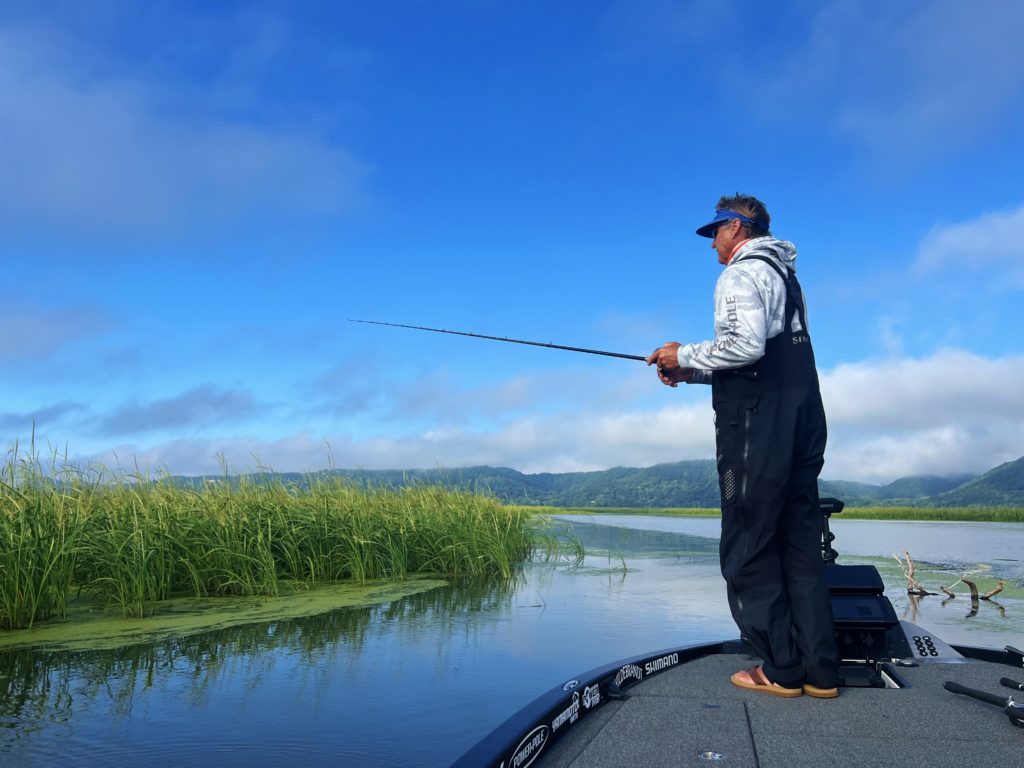
As I passed Root River — a major feeder creek on the west bank — I noticed an abrupt color change. Mud was pouring into the main river channel and headed south. When I reached my starting spot, I saw Chris Johnston already working the best stretch.
Disappointed by that, I idled to a nearby edge and dropped the trolling motor, hoping to get a jumpstart on the day.
But as I made my first few flips, I could see the water level was still super low. It was muddy, too. Still, I thought I might be able to scratch out a few fish.
It never happened. Within the first hour, I saw Chris pull his trolling motor and leave the area. I soon followed. I told my marshal we were moving up to Pool 7, praying the conditions there would be better.
After 45 minutes of locking time, I finally reached the best stretch. And in minutes, I put my first two largemouth in the boat. Soon after, I set the hook on a big one that managed to bind itself in the reeds and pull free. A few flips later, it happened again.
Beside myself, I continued to the end of the reed line, then motored to the mat of duckweed just upstream.
In just a few casts with a frog, I got bit. But the fish was well short of the 14-inch requirement. A few casts later, a 6-pounder exploded completely out of the water, knocking my frog three feet to the side. I quickly retrieved it for another cast, which the fish struck at again, but that was it. I tried numerous more presentations — even with a punch bait — but the fish never returned.
Disgusted, I continued to dissect the mat with the frog, only to get a few refusals from smaller fish.
Near the mat of duckweed was a shallow sandbar with a steep drop. At its down current edge, a school of bass erupted on a pod of baitfish.
Immediately, I fired a Shimano World Pop to the school and a 3-pounder inhaled it. A few casts later, one about two pounds also ate the popper. At that point, I thought I could save my day. But as the time ticked away, those proved to be my final keeper bites of the day.
A Last Gasp
On day 2, I decided I would spend the entire period fishing in the upper pool. But when my number was called and I reached the lock, there were two commercial barges already ahead of me. One was entering the lock, the other was on standby.
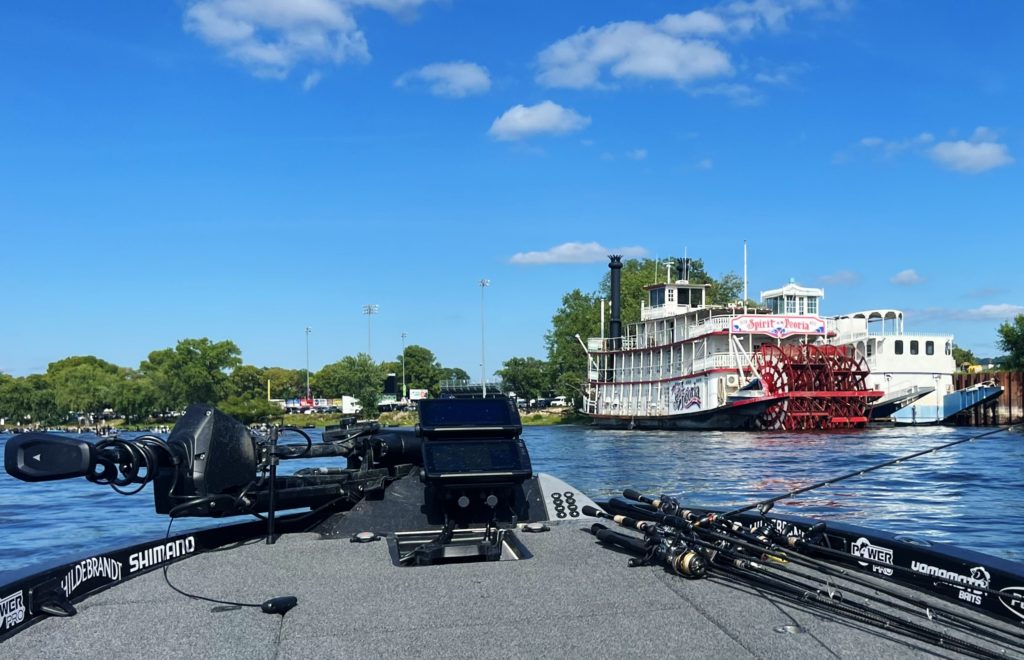
I knew it would be hours before I could reach the upper pool, so I abandoned that and headed south to try the flipping fish once more on the lower end of Pool 8.
When I arrived, the water appeared less stained than the day before. That lifted my spirits. But as I probed along the edge of the vegetation, it was clear the fish were no longer there.
Challenged by what to do next, I pulled the trolling motor and headed to the flats at Stoddard Landing.
An hour later, a line of thunderstorms moved in. With Lightning crashing all around, I raced to the nearest boat ramp to seek shelter. There, I found Clent Davis, Bryan New, and Ed Loughran, all huddled beneath a small pavilion. After an hour or so of exchanging fish stories, we all headed back out.
Resuming where I left off, I tried a number of lures and techniques. And as the hours passed, all I had to show for the effort was a single 2-pounder. The day was a complete bust. Disgusted with myself, I motored back to weigh-in, wondering where it all went wrong.
Final Thoughts
What began as a solid start to the season, ended up as a complete disaster.
Although I made enough checks to recover my entry fees and requalify for next season, all I could think of were the many lost opportunities that kept me from another Bassmaster Classic berth.
One thing is certain, I’ll have plenty of time to reflect while preparing for next season. Stay tuned!