
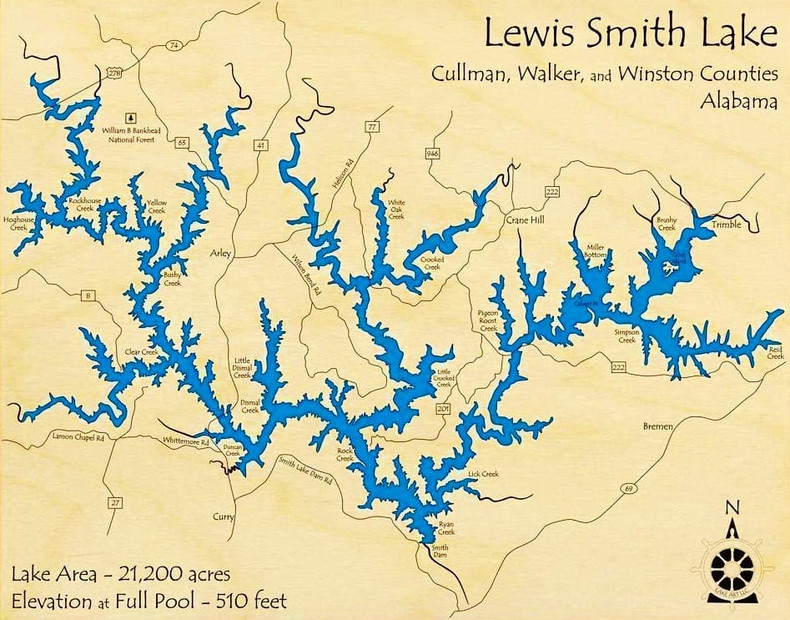
Occasionally, the Bassmaster Elite Series visits highland reservoirs, and this year Alabama’s Smith Lake made the schedule. When it was announced, reactions were mixed — some for, some against.
It’s not that Smith is a bad lake. It’s not. It’s just that B.A.S.S. scheduled it in late June when it’s 98 degrees in the shade and the lake becomes a playground for jet skiers and wakeboarders. Formed with steep banks and narrow passages, the wave action never seems to dissipate.
I’ve competed on Smith Lake twice before and neither time was during the summer months. But what concerned me more than watercraft traffic was the lake’s 15-inch minimum size requirement for all species of black bass.
Smith is known as a spotted bass factory, but 90 percent of them measure well below the legal length. With that in mind, I decided to concentrate much of the practice period on finding largemouth — a subspecies whose numbers pale in comparison.
Adding to the challenge was the more than 500 miles of shoreline to search through, and less than three days to do it in.
Practice Begins
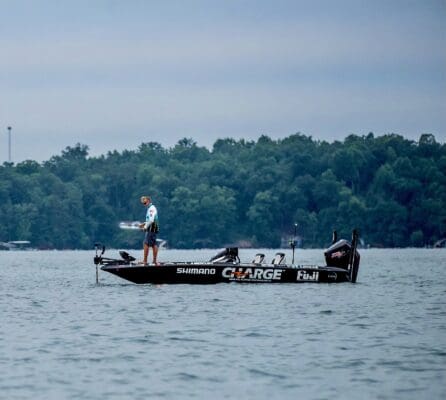
On day 1, I launched at the dam to run some nearby pockets, hoping to find a shad spawn underway. But after numerous stops, it was apparent that wasn’t happening.
From there, I transitioned to points, trying various topwater baits — none of which yielded a single keeper.
Next, I tried several jerkbaits, including Shimano’s World Minnow and World Diver. But those, too, weren’t producing.
At that point, I decided to run way up the western arm of the lake, to search for largemouth. After hours of probing, however, I managed only a few bites. It was a disappointing day, but I wasn’t totally discouraged. I still had two more to figure it out.
The next morning, I returned to the dam and then headed up the eastern arm — the designated tributary for official take-off and check-in for the event.
Running from point to point, I started scoring on 15- to 16-inch spots using a shaky-head Yamamoto Sensei Worm and drop-shot Slim Senko. The bite was steady and encouraging, but my biggest fish ranged only around two pounds. I felt I needed something bigger.
From there, I headed to the backs of several creeks to search for more largemouth. In one particular arm, I found what I was looking for — numerous 2 to 3-pounders holding in shade pockets along the bank. Some reacted to a hollow-body frog, others to a Shimano World Pop. Still, others preferred a wacky-rig Senko.
I filed that away and finished the day searching for similar areas.
On the final day of practice, I headed back up the western arm to search the backs of more creek arms. But after hours of trying, I found only one that held any potential. The rest of the day was spent checking points for spotted bass.
Throughout practice, I noticed a number of competitor boats fishing over super deep water — some at more than 100 feet of depth. Knowing they had to be fishing for suspended spotted bass, I wrote it off, thinking that approach would be too random. Instead, I remained focused on my game plan … a big mistake in retrospect.
Tournament Time
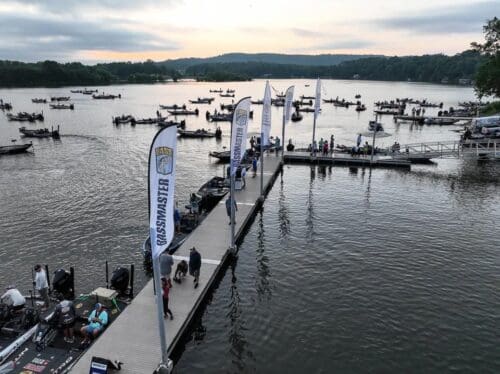
Having a mid-flight number, I sat patiently as half the field exited Smith Lake Park ahead of me. When my number was called, I fell in line and proceeded through boat check.
It was raining and much cooler than the previous practice days … everything pointed to a good largemouth bite.
When I arrived to the back of my starting creek, no one was there. Excited by the prospect of having it all to myself, I began casting the World Pop to shoreline targets.
Expecting a quick bite, I experienced anything but that. The fish weren’t reacting at all, so I substituted the popper with a Shimano Macbeth Flat crankbait in a shad pattern and immediately caught a 2-pounder. After placing that one in the livewell, I missed the next three. Each time, I could see the fish race off the bank and swat at the lure, but none would connect. It was so frustrating, especially seeing that all of them exceeded two pounds … one even in the 3½-pound class.
Shortly after, the rain stopped and the sun broke through the clouds. Then the bite died.
I stayed another hour trying to force things, but it was like the Dead Sea. Frustrated, I pulled the trolling motor and started running points on the main lake, hoping the spotted bass I found in practice would save my day.
At the first point, I quickly scored a number of shorts, then I finally caught a 2-pounder. A few minutes later, I scored another keeper. Things were looking up, but time was short. Having a 2:30 pm check-in, I knew I had to work fast. And though I caught a number of fish in the remaining time, I never scored another 15-incher.
Back at weigh-in — while bagging my fish — I took a last-second measurement on the largemouth. Thinking it was easily a keeper, I soon realized it no longer touched the 15-inch line. Disgusted, I released the fish and took two skinny spots to the scales.
Derby Day 2
The next morning, I decided to start on the largemouth again. When my number was called, I exited Smith Lake Park and raced once more to the back of my small creek.
When I arrived, I stopped short of the juice to try some laydowns. Switching to a Whopper Plopper, I immediately scored a 2-pound spot. With that one in the box, I looked ahead to the next strike. Unfortunately, it never came. And by 9 am, I had given up on the topwater bite altogether.
Switching to the Macbeth Flat, I detailed the entire backend of the creek but to no avail.
From there, I moved to an underwater saddle connecting the shoreline with a small island. That’s where I boated two more keeper spots. A while later, I scored another. The rest of the day, however, yielded nothing but short fish. Back at the scales I registered an anemic 7 pounds, 10 ounces.
Dehydrated and disgusted, I retreated to the house to pack my gear for the long ride back to Florida. Stop 7 on the Bassmaster Elite Series wasn’t kind to me, and I was ready for a break.
The New York Swing is next. Stay tuned…