

By Bernie Schultz
The first time I competed in a B.A.S.S. event on this TVA lake, I caught two 8-pounders. One came on the first day of competition, the other on the second. I also caught my first 5-pound southern smallmouth in that event.
Although that might suggest a strong bite, the fishing was actually quite tough. Only a handful of single-day limits were caught during that tournament and, because of those key fish, I finished in the top five.
Like that event, this one would also prove to be a serious challenge.
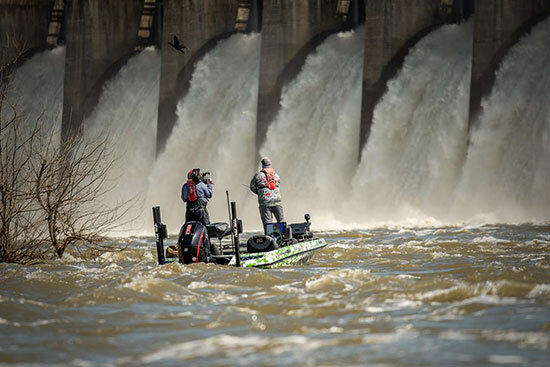
Wilson Dam's flood gates pumping immeasurable amounts of water into Pickwick Reservoir.
During the first two days of practice, the conditions were perfect. Temperature, water color and water level were all very favorable and stable. But on day 3, things changed dramatically, and as you’ll soon learn, the patterns I developed were flushed downstream with an ensuing flood.
Practice Begins
The first morning of practice, I launched at McFarland Park — our headquarters for the event. From there, I crossed the river to a gravel bar extending between two bluff walls. Studying the current break with my Garmin LiveScope, I could see plenty of life below the boat.
My first cast produced a nice spotted bass, about two pounds. The next yielded a striper. Then a white bass struck … and another, and another. After 20 minutes of that, I decided to move downstream to a power plant and crank a square-bill in two to six feet of water along the main-river ledge.
In minutes, I had my first 15-inch keeper. Shortly after, I hooked up with one I couldn’t turn. Minutes later, I caught a 5-pounder. To be sure I wasn’t overlooking something, I moved to the other side of the bar, to see if the fish I had caught were part of a bigger school nearby.
A half hour later, with no action, I returned to the main river drop and caught two more fish over three pounds.
Throughout the rest of the day, I moved further downstream — trying different depths along the main river drop — not really expanding on my initial find.
On day 2, I went straight to the same productive stretch of river, but to the opposite side. Again, I cranked along the drop at a depth of two to six feet. In minutes, I connected with several largemouth. Big ones, too. The first was nearly four pounds. The next was slightly larger. Then I hooked into a 6-pounder. It was almost too good to be true.
Amazingly, few other anglers were probing the main river bars in that area. Most were on the bank or fishing over submerged grass on the flats. Thinking I might be missing something, I tried those also but to no avail. When I returned to the channel, I quickly connected with more quality fish. The pattern was so solid, I believed it had the potential to win … if others didn’t crowd the area.
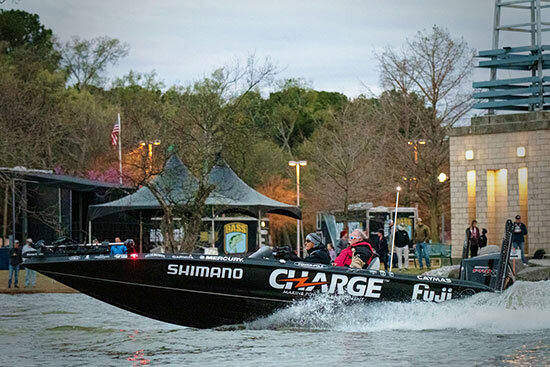
After two postponements, B.A.S.S. finally gave us the go ahead to begin the competition.
Satisfied with that, I headed to Second Creek to see if I could establish a backup.
Starting at the back in a flooded field of stumps, I immediately caught a 4-pounder on a 1/2-ounce Hildebrandt Tin Roller spinnerbait in the alewife pattern. From there, I moved to the closest steep bank and got several bites alternating between the spinnerbait and square-bill. The fish were smaller, but their numbers seemed sufficient.
My last stops of the day were spent on the main river, checking pea gravel points at the mouths of spawning pockets. Again, I got a bite or two, but nothing that would compete with the fish I found upriver on the drops.
During the early morning hours of day 3, all hell broke loose.
At sunrise, B.A.S.S. issued a safety warning alerting us to the potential for tornados, hail and violent electrical storms in on our area. The winds were already gusting over 25 mph, and wall clouds were forming to our southwest. Seeing that, most of the Elite Series field dismissed any notions of practicing … me included.
My original plan for the day was to scout the tailrace beneath Wilson Dam — a place where many tournaments are won. But I never go that chance. As a result, my game plan was now centered on cranking the main river ledge down the lake.
Competition Time
On the first morning of competition, I sat in the take-off area in total disbelief, amazed at how much the river had swollen. It was at least three feet higher and still rising. Then word came from tournament officials that due to turbulent waters and predicted high winds, day 1 of the competition would be cancelled.
The next morning, another announcement came; Day 2 would also be cancelled.
By then, all the floodgates at Wilson Dam were wide open, pumping massive amounts of clay-colored water downstream. We wondered if B.A.S.S. would postpone the tournament until a later date. Then, on day 3, they finally gave us the go-ahead.
As I sat once more in the marina at McFarland Park, doubt began to set in. The water level was now a solid five feet higher. I questioned whether that and the diminished clarity would move my fish and, if so, how far? Would they move shallower on the same bars, or leave entirely?
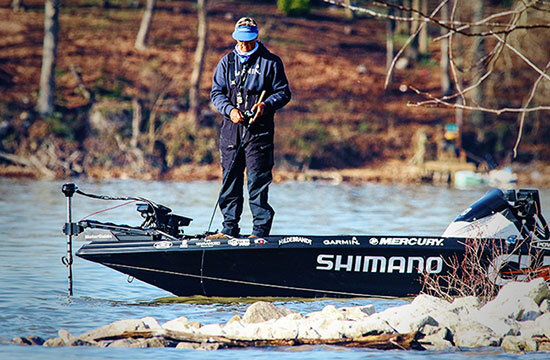
Main river bars produced quality fish throughout practice, but failed me during the competition.
Contemplating that, I proceeded through take-off and 20 minutes later, I shut down on my first waypoint. As I dropped the trolling motor, I couldn’t help but notice how stained the water had become, and the speed at which the current was moving. It was at least three times as fast as it had been in practice.
After 30 minutes, I knew the area was done. So I decided to try another similar stretch farther downriver. Again, nothing. From there, I headed down to Second Creek hoping to salvage the day.
Starting in the back of the creek, the once exposed stumpfield was now completely out of sight. I banged a crankbait through as many as possible, but nothing. I then tried slow rolling a full, ounce-sized Hildebrandt Tin Roller spinnerbait. Still nothing.
From there, I moved to the bank and started cranking a 45-degree drop. In minutes I had my first fish — a non-keeper. Minutes later, another. A half hour later, I caught a 2-pound largemouth. Then I hooked into something big that stripped line and eventually pulled off. At that point, with no better option, I committed to the area.
The rest of the day was spent catching small bass and drum, and losing two other keepers.
Back at weigh-in, it was clear the changing conditions had hurt the overall catch. But not for all. Some of the anglers had crushed them — saying they found them by fishing in areas that were completely dry just a few days earlier. With that, I retreated to the cabin contemplating my next move.
A Last Gasp
The following morning, the water had dropped about a foot. It was also a bit clearer. That convinced me to try the main river again. So I repeated my morning stops from the day before, hoping for better results.
Sometime after 8 a.m., I boated a 2-pound smallmouth, but that was it.
Disgusted with the lack of action, I headed for the bank. My first stop was to a line of flooded reeds — pitching to them with a black and blue 1/2-ounce jig with Yamamoto Fat Baby Craw trailer. I hooked a drum and several largemouth shy of the 15-inch size requirement, but nothing else. I then moved to a nearby bank of flooded trees and shrubs. Again, no keepers.
Next, I tried a series of short pockets, cranking over the shallower ditches leading to their back ends. Still nothing.
Frustrated and confused, I moved back to the main river — this time, fishing over flooded grass with a lipless crankbait. Whenever a piece of wood came within range, I would pitch the jig.
Finally, an hour before weigh-in, I caught my second keeper of the day — a 2-pound largemouth.
The remaining minutes were spent near check-in, trying to catch a big smallmouth. That, too, never happened. And when it was all said and done, I finished near the bottom of the pack.
Looking back, I should have dismissed the main river drops and gone straight to the bank. Ohio pro Bill Lowen won the event by — you guessed it — pitching a black and blue jig on shoreline cover. Although I tried to make that pattern work, Pickwick is a huge lake with miles and miles of shoreline, and it all looks deceptively good. I simply chose the wrong areas.
With Pickwick in the record books, it’s now on to the next one. Stay tuned…