
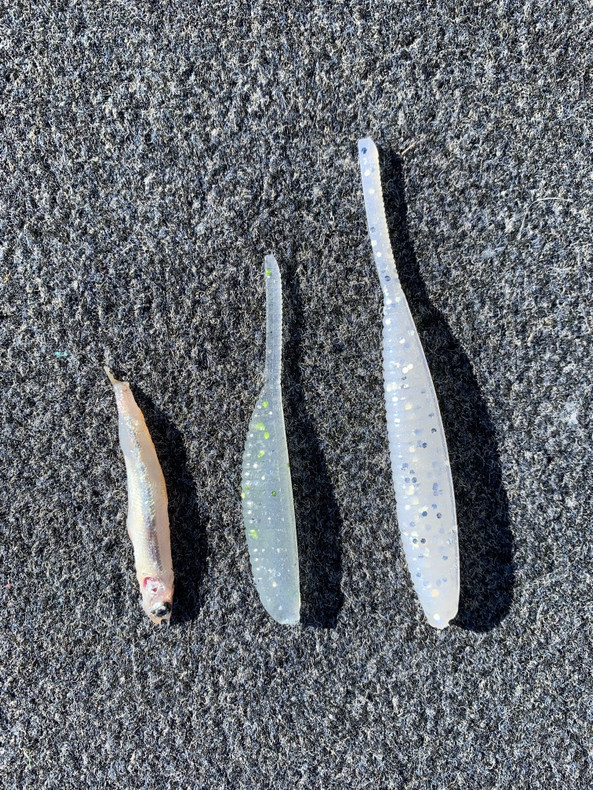
For years, the 3.75” Shad Shape Worm has been one of my favorite soft plastic baits. Its shape and profile make it the ideal baitfish imitator. If you follow the Inside Line you know that I have written about it on more than one occasion. So when I found out at ICAST that Yamamoto Baits was releasing a smaller 3” version and a larger 5” floater you know I was super excited.
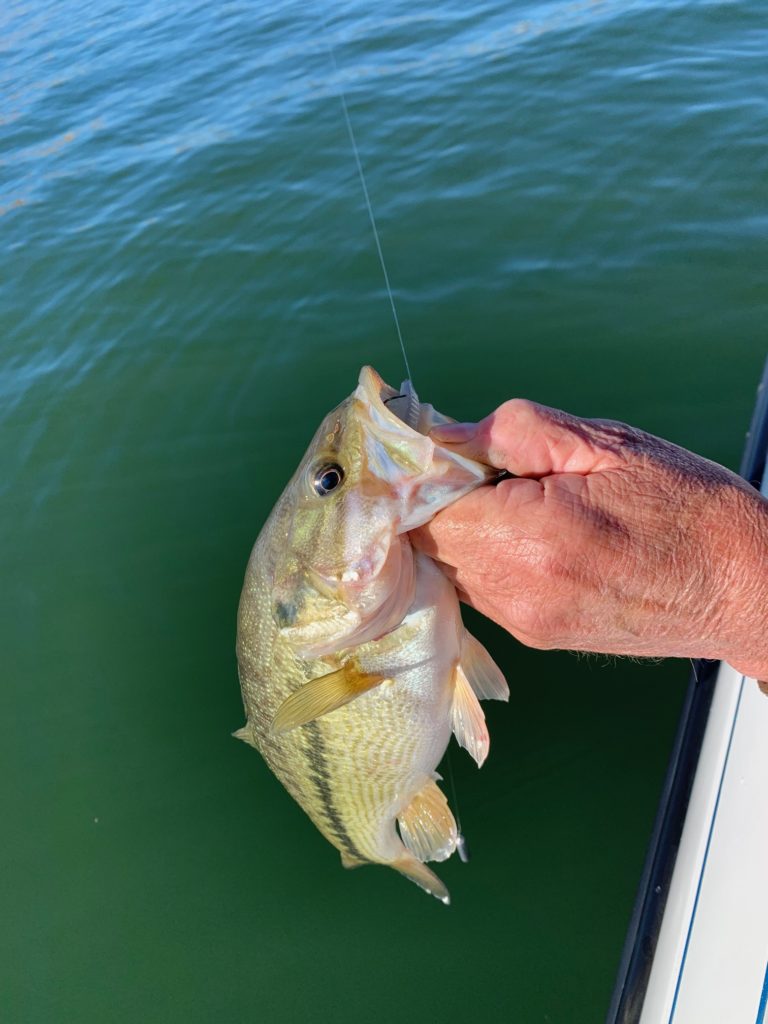
Over the past few months, I have had the opportunity to spend lots of time on the water with the new 3” Shad Shape Worm. It is an amazingly effective bait, it retains all of the fish-catching attributes of the original just in a smaller package. I have caught plenty of fish on the new bait and when conditions call for a smaller offering, it is my belief that you would be hard-pressed to find a better option.
Match the Hatch
Lake Oroville is one of the best spotted bass lakes in Northern California. Primarily known as a numbers lake, Oroville is one of my favorite lakes and the fall is a great time to fish there. Schools of marauding spotted bass have one thing in mind and that is gorging on swarms of pond smelt in preparation for the winter. The pond smelt can be small this time of year and the bass can get really keyed into the size of the bait. This is a classic match the hatch scenario and it was the perfect opportunity for me to put the 3” Shad Shape Worm to the test.
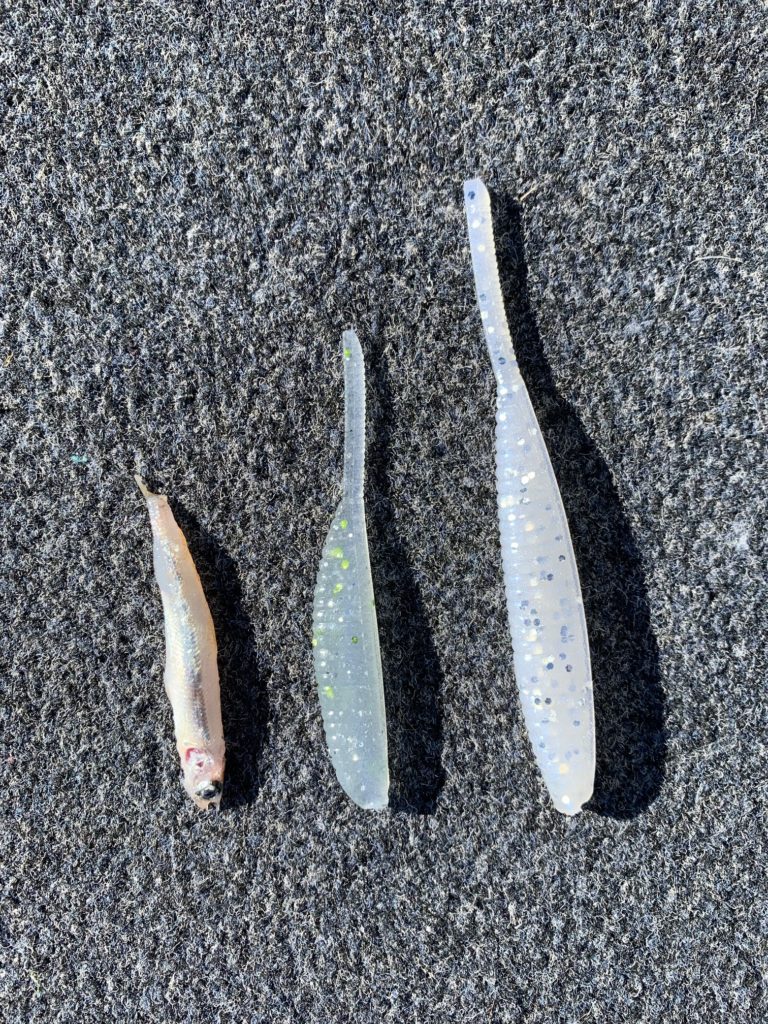
I found big schools of suspended pond smelt in 30' to 50' loosely relating to bluff walls, long sloping points, and submerged island tops. I used my forward-facing sonar to hunt small groups of spots relating to the bait. The first fish I put in the boat validated my decision to fish the 3” Shad Shape Worm when it spit up small pond smelt all over the front deck. I had success alternating between a Sexy Shad (9005) and a Pro Blue (9006) colored bait that I fished on a 1/8 oz darter head jig. The key was to make long accurate casts and to slowly swim and shake the bait above the fish, a technique known as mid-strolling or locally by the old guard as the Nate Shake.
If I needed to get my bait a little deeper in the water column or if there was a lot of wind I switched up to a heavier 3/16 oz jig head. For this presentation, I like to use a 7' medium light action spinning rod matched with a 2500 series spinning reel spooled with 10lb high vis braid and a 30' length of 5lb top shot fluorocarbon line.
Pressure Relief
When the dropping water forced the closure of Oroville's last paved low-water ramp, I decided to make my way over to Lake Berryessa. Berryessa is a special fishery as it has a healthy population of spotted bass, largemouths, and smallies and it is not uncommon to catch all three species of bass on the same day. Like Oroville, the key to Berryessa this time of year is to find the bait, in this case, threadfin shad.
I spent the majority of my time graphing structure and looking for shad. It's not unusual to go all day graphing and fishing in lots of areas with little success. Just because you can see them, doesn't mean you can get them to bite, but when the stars align you can get well in a hurry. After eliminating a lot of water, I found the shad bunched up in 40' to 55' about halfway to the back of several long steep cuts. Again my forward-facing sonar was a big key in targeting active groups of fish as they pushed around the shad schools. My initial offering was a 4” Natural Shad (906) colored Shad Shaped Worm rigged on a dropshot and it was the perfect match for the size of the bait.
As often happens, once you catch a few fish from the group, the school starts to get wary and the fishing pressure can shut the bite off. When this happens, it can be a grind to trigger them again. Downsizing is a great way to get the fish to bite again and the 3” Shad Shape Worm was the perfect solution to extend the bite. Once the fish shut off completely, I left them with the intention to return at a later time.
Rotating through a few key areas, I used my forward-facing sonar and my GPS to relocate the schools of shad. Even after I let an area rest for a while, the fish were still hesitant to bite again. Thankfully I was able to squeeze out a few more bites with the help of the 3” Shad Shape Worm. I fished a number of different colors with Sexy Shad (9005) and Natural Shad (306) being the most productive.
For the times when less is more, I am super excited to have the new 3” Shad Shape Worm in my arsenal.