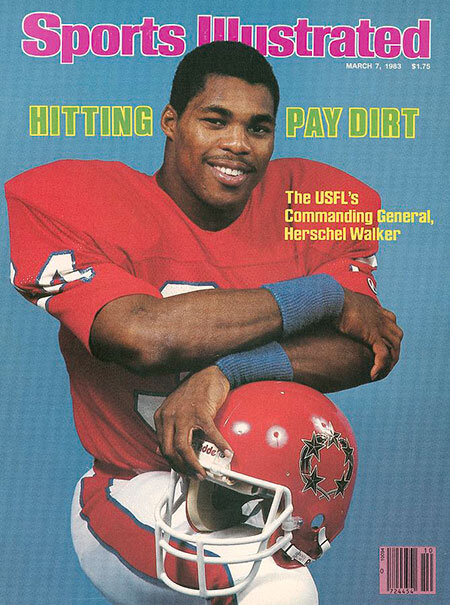

I’m not quite old enough to have vivid memories of professional basketball’s ABA, but I do remember the USFL. I even went to a game between the New Jersey Generals and the Baltimore (or was it Philadelphia) Stars at the University of Maryland’s Byrd Stadium that included two of the most memorable college football stars of that generation – Doug Flutie and Herschel Walker.
Flutie, despite a lengthy career in the NFL, is not in Canton. He is, however, in the Canadian Football Hall of Fame and the College Football Hall of Fame.
Walker is in the College Football Hall of Fame, but not the pros’ hall. As my Bassmaster editor Bryan Brasher recently explained, part of that is because he “spent the prime years of his career playing in a league that no longer exists.”
If you had told the average fan in the early 80s that neither would end up in the Pro Football Hall of Fame, they might’ve believed it for Flutie, but not for Walker. I mean, absent a career-ending injury he was destined for greatness. Nothing else could stop him except….himself. He’d won the Heisman Trophy, the Maxwell Award, had been an All-American and SEC Player of the Year three times apiece. He had one really great season with his first NFL team, the Cowboys, but after that, he spent a decade as a good but not exceptional NFL running back.
Among average fans, he’s known more for how his trade to Minnesota helped the Cowboys’ long term fortunes, as well as the fact that he competed in the 1992 winter Olympics on the bobsled (!). If you combined his USFL and NFL rushing yards, he’d be fifth all time, and his combined yardage would be first all-time.
So why isn’t he in the Hall?
Those of you who are more avid students of the game than I am might proffer other theories or factors, but I cannot help but think that part of it is that he isn’t associated with a single team or a single league. Yes, there are plenty of ABA and USFL players who ended up in the Hall (Reggie White, Gary Zimmerman, Jim Kelly and Steve Young are among the latter group), but I kind of assume that their induction was in spite of competing in multiple leagues, not because of it.
How many first ballot Hall of Famers can you think of who aren’t associated primarily with a single team, or at most two teams? The only one from football who immediately comes to mind is Deion Sanders.
So what the hell does all of this have to do with fishing?
Well, as a student of the sport (or at least more of a student than I am with football or basketball), records and statistics matter to me. I care about whether KVD or Clunn or someone else will win the most Classics. I care about three- and four-day weight records. I care about Angler of the Year titles. But with the existence of three major tours now, plus a good selection of AAA and other standalone derbies, it’s hard to make an apples-to-apples comparison of anglers’ careers.
Jacob Wheeler, Jordan Lee and John Cox may be the three current anglers with the best chance to have dominant careers over the next decades – their long-term records might end up rivalling what KVD or Bryan Thrift have done. Even still, that were always be questions, or concerns, about what their stats really mean. I don’t have enough of a crystal ball to see the various leagues’ futures, and to discern whether any of the anglers listed above (or any others) will move from one to another – but I do know that the discussion of the game is starting to resemble boxing’s alphabet soup more than anything we’ve ever experienced before.
The anglers themselves may not care. After all, they’re trying to pay their bills, both short- and long-term, and assumedly they’re following the path that they believe best enables them to do so. For the rest of us, though, it provides uncertainty as to what it all means. Do two Forrest Wood Cups equal one Redcrest? Does a late 90s B.A.S.S. AOY add up to a Redcrest and three FLW wins? It’s great for bar room debates, not so good for figuring out who’s the GOAT down the road.