
By Gary Dobyns
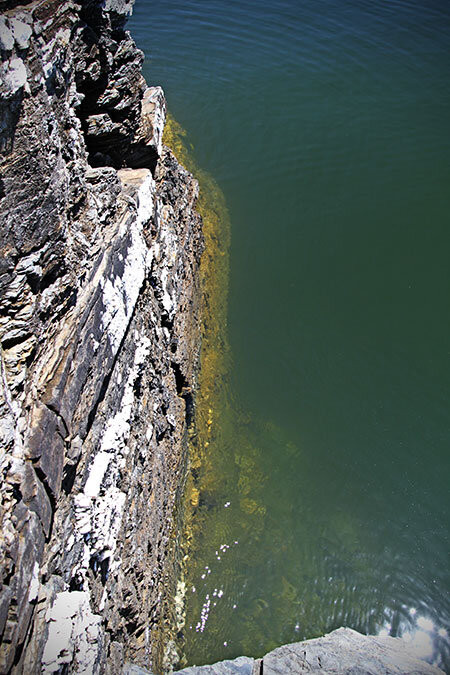
When I think about vertical rock structure, I lump traditional reservoir bluffs and steep canyon lake walls in the same general category. To me, it’s a needle-in-a-haystack type of fishing, but if you approach it with a disciplined and thorough game plan, you’ll often catch a bunch of fish.
For me, it starts with recognizing why fish use bluffs in the fall. The first benefit is the vertical profile, which allows the fish to adjust their depth by moving up and down, rather than in and out. Also, as the rocky surface absorbs the sun’s rays, a bluff can be a source of warmth, which attracts the baitfish that bass will be looking for in the fall.
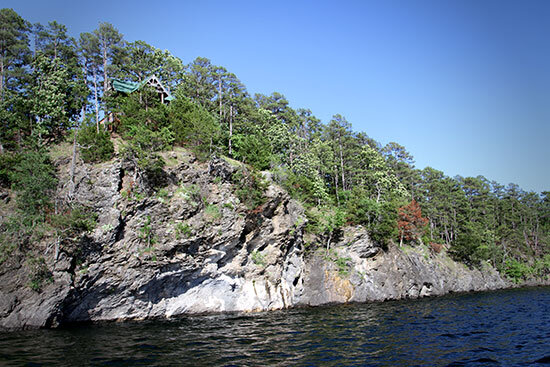
In most cases, a bluff is divided into three main sections: the actual wall, a step or ledge out in front and the tapering bluff end. Initially, I’ll hit all of these sections; I don’t think you can eliminate them until you’ve fished them.
It’s trial and error. You might eliminate a section once you fish a couple of bluffs, but at first, I think you have to look at them all.
Conditions have a lot to do with where the fish will be holding — whether the day is sunny or cloudy. You also have to pay attention to where the bait is.
I’ve also found that spotted bass, in particular, really like to suspend out in front of the bluff walls. The largemouth will do this too, but spots really seem to prefer holding out in front.
Top Presentations
Given the diverse elements of a bluff and the fact that fish position along these spots in different ways, I like to use a selection of baits that allows me to cover the water and hit all the key areas.
Spinnerbait
I like slow rolling a spinnerbait along the bluff wall and most of the time, it will be a 1/2- or a 3/4-ounce. Colors may vary based on where I’m fishing, but generally, it will be something with some shad or chartreuse in it.
I don’t like trailer hooks, but I do use a Yamamoto Super Grub as a trailer. Sometimes, I’ll use a 4-inch, but generally, a 5-inch.
I usually prefer double willow-leaf blades and if I’m fishing deeper, I’ll use smaller blades — like No. 4 — so the bait falls better. This lets me slow roll the bait deeper.
Rod: 734 Champion with 12-pound fluorocarbon. That line’s heavy enough that I’m not going to break off a fish, but I can still slow roll a spinnerbait without the line hampering me.
Crankbait
I like a Storm Wiggle Wart, a Norman Deep Little N and a SPRO Rock Crawler.
Rod: Champion 764 CB with 10-pound fluorocarbon. That’s strong enough that I’m not breaking anything off and it lets me get some depth out of the bait and allows the bait to work really well.
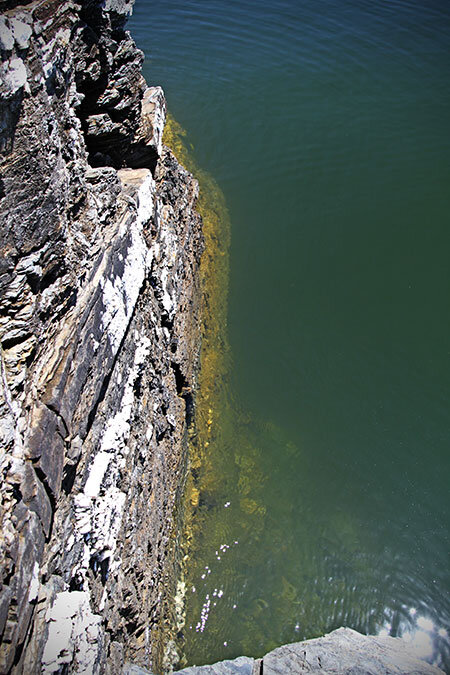
I’m parallel casting and retrieving right along the bluff wall. I don’t necessarily burn the baits, but I don’t fish them really slow either — it’s kind of a medium retrieve. I’ll grab a spinnerbait first, but sometimes, that crankbait will fish circles around the spinnerbait.
Most of the time, I’m throwing as close to the bluff as I can without hitting it. I know everyone is into deflecting off of a rock; and if it does, that’s fine. But I just try to fish the bait straight down in the water column and it’s more of a straight reaction bite.
Wacky-Rigged Senko
Honestly, I believe you’ll get 10-to-1 bites on a wacky rig, versus a Texas-rigged Senko. I’ll just let it flutter down to whatever depth I think the fish are at — hopefully, not more that 10-12 feet — and then I’ll reel up and make another cast.
I use it strictly as a fall bait; the bait’s working as it’s falling. I just make a bunch of casts and I don’t cast close together. If I don’t get a bite, I’ll throw it up the bank at least another 30 feet.
My main color choices are natural shad and baby bass and if I ever feel that I need a faster fall or a little different look, I’ll stick a 3/32-ounce nail weight in the Senko’s head. I make a Dobyns D Nail, which features a sharp point, extra large ridges for a secure hold and a football head, which allows you to feel the bottom makeup.
Rod: DX 743 or DRK 753 spinning rod and 8-pound fluorocarbon. You can feed the line off easier with spinning tackle and a lot of times, you’ll see the bites in the line while the bait is falling.
This is a super fun way to fish because you see the line hop. It’s just a kick; I really like fishing a weightless Senko.
Dart Head: This is not something that anglers throw much in the Eastern U.S., but it’s a popular technique out west. I can think of several times when I’ve had to fall back on this technique to salvage a tournament. When everything else isn’t working and I’m just trying to get bit, I can almost always catch fish on a dart head.
I’ll use a 1/8-ounce head with a Roboworm and let it fall down the face of the bluff. There’s always stuff for it to hit on the way down, so I’ll let it fall slowly and hit a rock or a ledge or something on the way down. I’ll let it sit there and shake it, pull it off and let it fall again.
Rod: DX 743 spinning rod and 8-pound fluorocarbon.
The dart head’s a very productive technique. You’ll catch a lot of fish, but the thing you’ll struggle with is size. You’ll catch a lot of smaller fish too, because you’re going to get bites.
When I’m selecting bluffs, I like a windblown spot because that tends to stimulate the reaction bite. Also, I like bluffs at the mouths of creeks because I know I’ll have fish coming and going.