
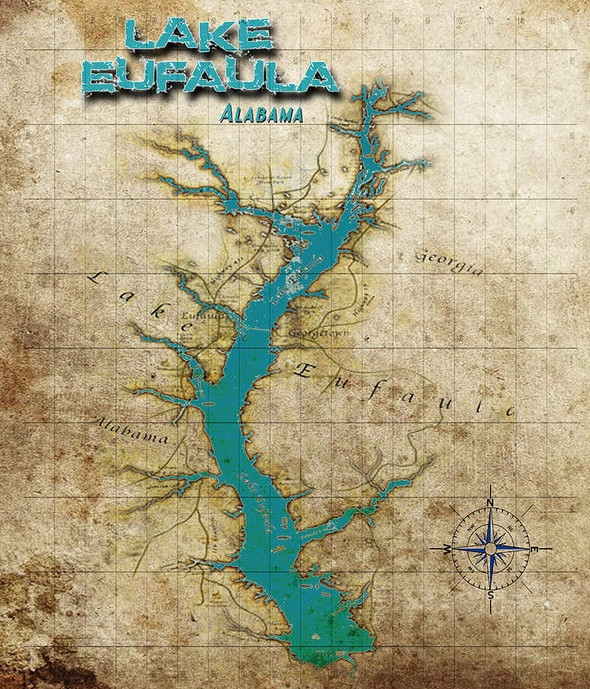
Part of the Chattahoochee River system, Lake Eufaula proper begins just north of Lake Point State Park at Cowikee Creek and stretches southward about 30 miles to the dam. It serves as a boundary between Georgia and Alabama, and offers approximately 45,000 surface acres of fishable water.
Among its targeted species are spots, largemouth and shoal bass. But to win a derby on Eufaula, you better concentrate on the largemouth. They are much bigger on average, and there are plenty of them.
Because B.A.S.S. scheduled our event on a full moon in April, I figured the spawn would be in full swing — especially after a long warming trend. In retrospect, however, that wasn’t the best pattern. As the event unfolded, forward-facing sonar became the dominate player.
Practice Begins
On day 1 of practice, I decided to trailer north from our cabin to Lake Point Marina — official headquarters for the event. The forecast called for strong winds and I knew that part of the lake would be better protected.
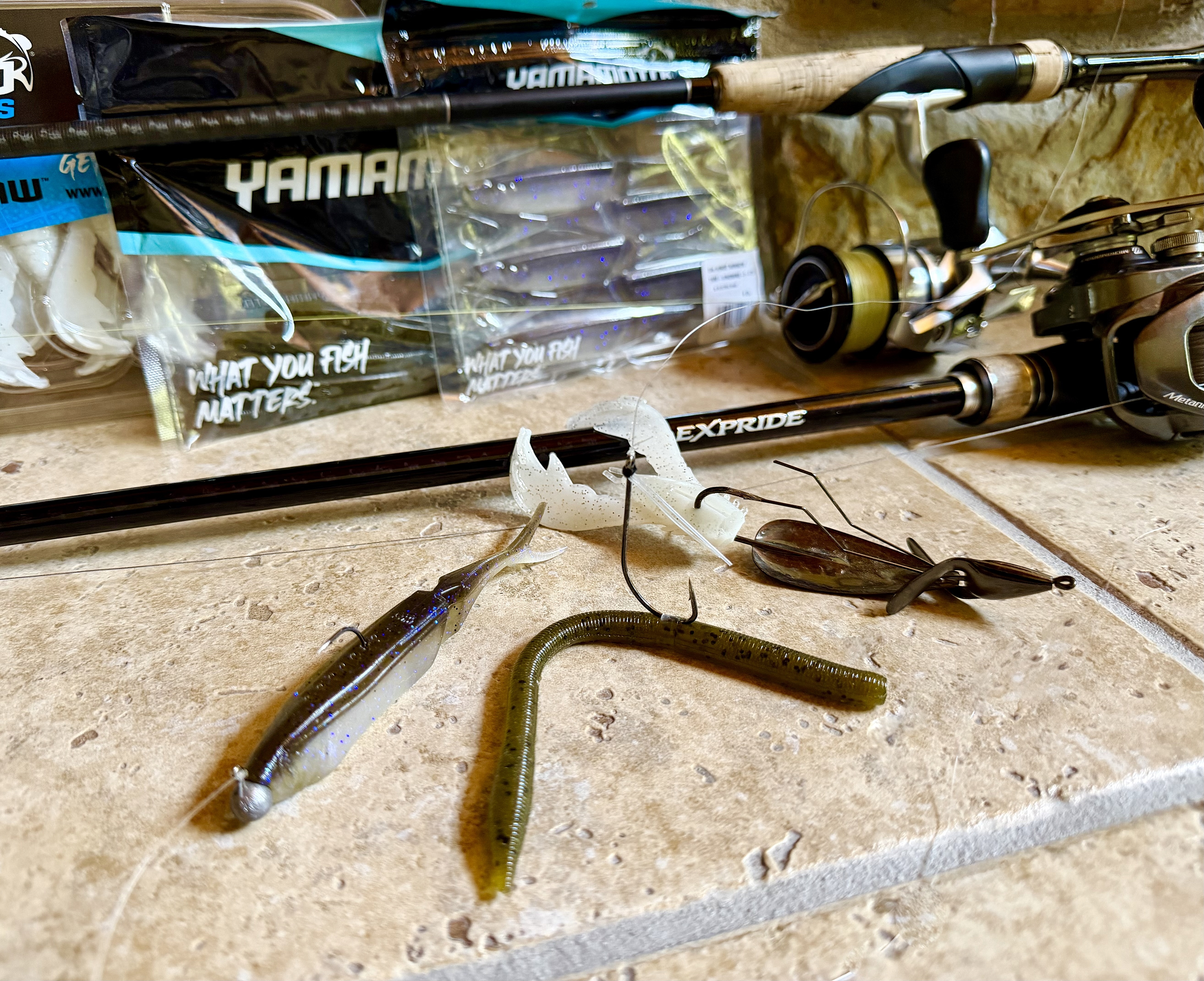
After launching, I motored out of Cowikee Creek to a familiar flat just up the main river. There I found a field of dead lily pad stems, bordered by mats of floating vegetation. Within minutes, I was shaking off what felt like quality fish. The first few bites came pitching a green-pumpkin Yamamoto Yama Craw to the edge of the mats. Two others came from the pad stems casting a white Chatterbait with matching Zako trailer.
With that in my pocket, I motored further north to a major creek on the Georgia side. Due to unusual scheduling, our practice days ran through the weekend, and the lake was experiencing heavy traffic. In fact, there was a large high school regional tournament out of the north end, which made it challenging to find an area to myself.
Seeing no potential in the creek, I moved back to the main river.
Paralleling the bank, I alternated the Chatterbait with the Yama Craw, depending on the target. That scored a few bites, but nothing larger than two pounds. From there, I ventured back down river to try a major creek on the Alabama side.
There, on a long stretch of emergent grass, I found numerous fish in various stages of the spawn — some building nests, others guarding fry. Among them were several females in the 4- to 6-pound class. Recording their locations on my Garmin GPS, I progressed along the shoreline and, by day’s end, I had coordinates for more than two dozen quality fish.
On day 2, I decided to launch on the lower end of the lake. From there, I ran across to Pataula Creek. At its mouth, I scanned for brush and stumps, finding both in abundance. Using a Buckeye jighead tipped with a 5-inch Yamamoto Hinge Minnow, I connected with numerous fish — both largemouth and spots. Two particular brushpiles seemed to hold the better grade, so I marked them and moved further south to several protected pockets. In two, I found numerous male bass building and guarding nests. Using a watermelon Sensei Worm rigged wacky-style, I shook off several of the more eager males. My confidence was building.
On day 3, I returned to the Georgia side and worked my way north. Late in the day, at the mouth of a small creek, I found my starting spot — a field of emergent grass holding numerous quality bass locked on beds. I marked each carefully, so that I could zero in on them under low light conditions.
Excited about my prospects, I returned to the cabin to prepare my gear.
Competition Time
The next morning was clear and calm, perfect for sight fishing. But having a late number in the take-off order, I wondered who might get to my starting spot ahead of me.
Eventually my number was called and I exited Lake Point Marina. Racing south past the bridges at Georgetown, I angled toward the Georgia bank. Flanking me were two other boats traveling in the same direction. One I beat, the other got to the creekmouth ahead of me. To my surprise, however, neither wanted the stretch of grass I was focused on. Seeing that was a relief.
As I worked my way toward the prime area, I began by fan casting a vintage Johnny O’Neil Weed Wing tipped with a white Yama Craw trailer. I tied the lure on the night before, thinking it might pay off … and it did. On my fifth cast, I connected with a solid 5¾-pounder. Shortly after, I scored another weighing three pounds, then a 2½. It was a great start, and I hadn’t even reached the prime area yet.
When the buzzer bite cooled off, I transitioned to sight fishing. The water level was noticeably lower, and that had the fish bothered. Eventually, however, I was able to finish my limit with the wacky-rigged Sensei Worm.
From there I ran to the Alabama side, to the creek where I had marked so many spawners on day 2 of practice. But as I moved to each saved coordinate, it was clear the falling water was taking its toll. Most of the fish were gone.
Continuing along, I eventually found two large males — one locked on a nest, the other guarding fry. Realizing neither would improve my weight, I decided to save them for the next day. It was a decision I would later regret.
I used the rest of my time searching for new fish, but found nothing that would help. When time ran out, I headed for weigh-in where I put 16-pounds of fish on the scales. That placed me solidly inside the cut, but with so many of my fish disappearing, I had serious concerns for day 2.
Another Shot
The next morning, the weather was clear and much warmer.
As I sat waiting for my number to be called, I deliberated on where to start. Should I return to the grassbed that was so productive on day 1, or try another area altogether
When my name was called, I exited Lake Point Marina and raced south to the bridges at Georgetown.
Once beneath the first bridge, something told me to turn east and try a small grassbed on the Georgia side. When I arrived, it was obvious the water had fallen even more overnight. The emergent grass was standing six inches higher. After twenty minutes of flogging the outside edge, I gave up and proceeded to the creekmouth below the second bridge.
Instead of picking up where I left off on day 1, I decided to try a stretch on the north side of the creek — a spot where I marked several fish during practice. But after an hour of trying, all it produced was a single 14-inch keeper. Even worse, during that time another competitor had moved into my sweet spot on the opposite side. I tried fishing inside the creekbed itself, but that yielded nothing.
From there, I ran back to the Alabama side, hoping for a quick recovery. The morning was slipping away and I needed to put some fish in the box.
As I retraced my steps from day 1, I discovered the two large males I had saved were now gone. It was so deflating. I thought for sure both would be right where I left them. At a loss, I went into scramble mode.
From there I raced to the mouth of Pataula Creek, hoping to fill my limit with scope fish. Stopping on the first of two key brushpiles, I put a couple of bare keepers in the boat. The second brushpile yielded nothing. Concerned for lack of size, I abandoned the area and ran to the creek where our cabin was located. (On the day of arrival, I walked the water’s edge and noticed several cruising fish and a pair trying to spawn — filing them away, just in case).
When I arrived, fellow Yamamoto pro Brett Hite was anchored on the bedding pair. When I got within range, he told me he, too, was having a tough day. A few minutes later, he pulled his trolling motor and left.
Fishing behind him, I managed one more keeper before trying the pair he gave up on. Seeing how large the female was, I dropped the Power-Poles and spent the remainder of my time on her. As the minutes slipped by, it looked more and more as though she was about to strike. On two separate occasions, she nosed down on the bait, and that kept me engaged … but for too long. Before I knew it, the time had slipped away and I was forced to leave.
Halfway back toward weigh-in, I realized I was going to be late. I ran across several skinny flats, trying to make up the time, but when I finally reached check-in, I was three minutes late. The day was a total bust and I was beat, both physically and mentally.
After crossing the stage, I spoke with a few fans then put the boat on the trailer … completely drained and dejected. As it turned out, it was a scoper’s tournament. Nearly all of the top 10 relied on forward-facing sonar. And that shocked me, having a full moon in April.
Follow Bernie Schultz on Instagram, Facebook or through his website.