
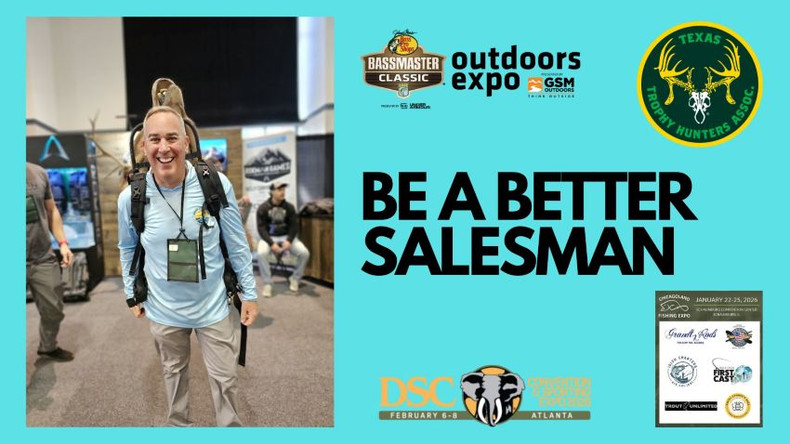
I’ve been attending various fishing or fishing-adjacent expos, extravaganzas and shows for over 30 years – everything from Bassmaster Classic expos to local Bass-a-Ramas and even flea markets. I’ve gone in when I expected to spend a lot and spent nothing. I’ve also gone in just as a lookey-loo and put a heavy tax on the credit card.
Over the past few years I’ve also worked some shows, both on behalf of the international fishing travel business that my wife and I co-founded, as well as for some of our clients and partners. It doesn’t come naturally to me. I don’t like selling. I resent puffery. Nevertheless, based on my long-term experience as a consumer, I know what I do and don’t like when I’m talking to a boat dealer, lodge outfitter or tackle rep.
Many of you look forward to the sales process. Working a show for a friend or sponsor is the next step in your efforts to build a fishing career. You’ll want to have immediate success to show your value. With that in mind, here are a few tips that I can offer
Know Your Product – As I’ve worked for our lodge partners, the pre-show homework consists of learning everything I can about what they offer. Of course, that starts with actually traveling there multiple times (or using the gear if you’re representing a product). Get your facts down ahead of time. Think of the ten questions you’re most likely to get (e.g., “What does it cost?” or “What is the best time of year to visit?”) and come up with not only both short and long answers, but also try to figure out the likely follow-up questions.
Don’t Denigrate the Competition – One thing that definitely turns me off is someone who puts down the competition. The Panama lodge we work with has one main competitor. We get asked about it multiple times per show. My answer is always: “I have several friends who’ve been there. They’ve all had a good time. I’ve never been there, so I can’t judge it, but based on what they’ve told me here are the differences I’d expect.” Whether you’re selling reels or crankbaits or gutter guards, follow that model.
Don’t Be Afraid to Check – You can’t know the answer to every possible question ahead of time. If you don’t know, or you’re not sure, ask someone you work for. While it’s not quite as good as knowing the information with certainty, it’s better than giving someone a wrong answer.
Get Off Your Phone – We’re all tethered to our smartphones nearly 24/7 today – and of course there are times when you’ll need to be on it during a show --but there’s nothing that’s a bigger turnoff to a potential client than strutting up to a booth to find all four or five people doomscrolling the day away. It shows that you don’t want to be there and/or that you’re not paying attention to them. If that’s your posture before you sell them a trip or product, how are you going to treat them once you’ve collected their money?
Try to Figure The Customer Out – Talking to a potential buyer is like working on a bedding bass – each one is different. Some want to tell you fish stories. Others care mostly about price. Some want to be left alone to look at your promotional materials. Don’t be the salesman who doesn’t at least try to figure out these differences. Figure out what’s important to the person standing in front of you – both in terms of product and process – and steer your boat in that direction.
Don’t Judge a Book by Its Cover – At the recent Texas Trophy Hunters Show, we watched as plenty of buyers spent tens of thousands of dollars on trips to Africa or New Zealand or elsewhere across the globe. Many of them came in distinct uniforms – specific forms of camo, or expensive boots and hats, or even coat and tie. There were also a few who looked like they might have been recruited from sleeping on the floor at the local bus station. Plenty of those guys have cash and passion for the outdoors, too, and ridiculous bankrolls to back it up. For the same reason, don’t ignore any potential class of customers based on gender, race or another identifying characteristic. It doesn’t
Don’t Ignore the Old Guys – This is a corollary to that last point. The young guys may be cooler looking and more dynamic in some cases, and may have money to spend, but generally your wealthiest customers will come in the 40+ or 50+ range. We sold a lot more trips at TTHA to guys with Hotmail or Yahoo email addresses than Gmail addresses.
Finally, as a confirmed introvert who fears public speaking, I feel perfectly situated to state the following: If you want to represent your sponsors or employer well, get your people skills in order. Practice your speaking, in the mirror, into a camera, or with a good and understanding friend peppering you with questions. Learn not to hem and haw or distract, but rather to get to the point.